Day two of our trek dawned a little clearer, so we and the cat had a little view from our home stay.
We ate a western breakfast of pancakes while the couple and our guide ate pho (noodle soup) in the kitchen. Even in this fairly remote village, wifi was availalbe, so Drew helped Nhu check her email.
We said goodbye to our hosts
And began walking. I had a crook in my neck from the lopsided bed the previous night, so I was already longing for our VIP room at the Sapa Luxury Hotel.
The clouds were lifting and we could get our first glimpses of rice paddies, water buffalo, and villages.
But we were on the tourist track. Busses come from Sapa bringing tourists for an easy walk through a couple of villages. Hoards of them with cameras.
Nyu quickly steered us off the main road.
Pigs seemed to be the theme of the morning.
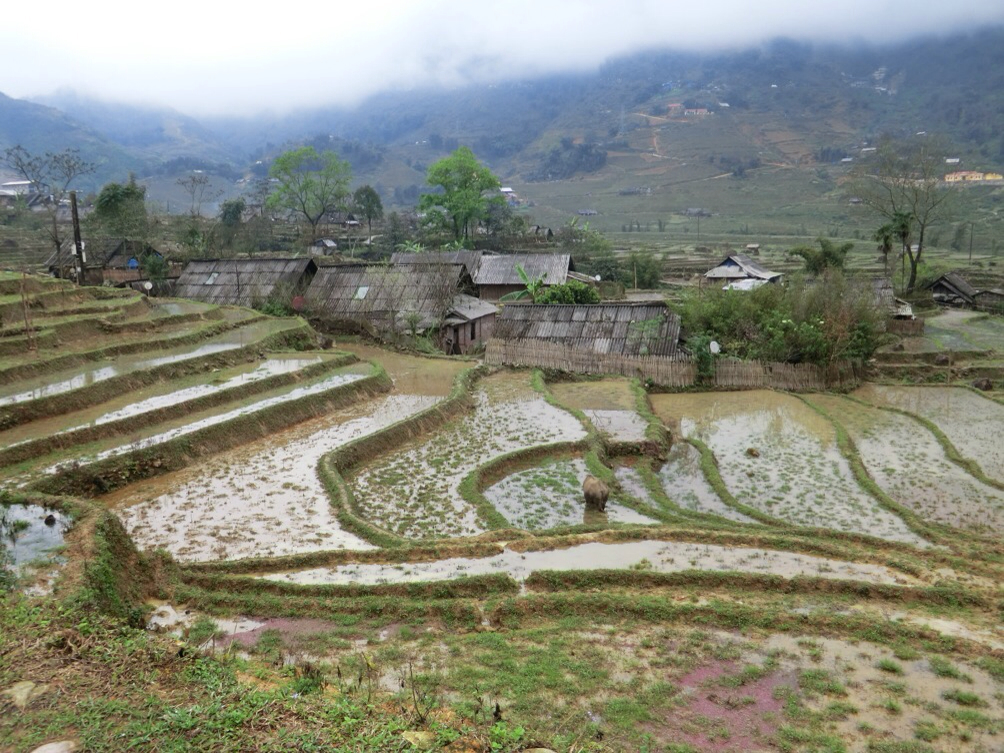
We were Always surrounded by rice patties. It is too cold to grow rice right now. The fields are planted inMarch and April and harvested in August And September.
The big yellow building top of the hill in the picture above is the school. Little Children go to primary school in the morning, then the older kids use the school for secondary school. Up until age 15, school is free. High school is in the city and families have to pay for it, so many kids are not educated past the half-day school up to age 15. Vietnamese is taugh in the village schools, but not English. The kids speak their native language at home (H'mong, Dzao, Tay, Thai, etc.).
More walking
Past more rice paddies.
We took a short cut up a steep hill.
No shortage of steep hills here, but every slope is farmed. The ratio of paddie to terrace is very small on this slope, but the population is growing and so more and more terraces are being cut.
The picture below shows a couple of things. 1. A nice landslide on the hill across the valley. 2. The amount of farmland needed for one family. The rice paddies on the slope in front of us that also has three houses on it (not the slope directly below us) is the amount of farmland needed for about 7 or 8 families.
The scar on the opposite side of the valley in the picture below is from a new water pipeline for a new hydroelectric plant. While we were at the home stay, the bill collector for the power company came to collect. For one month, their bill was $25 USD. That seems like a lot for a house with about 7 CFL lights, a TV, a computer, a wifi router, and an electric on-demand water heater. Maybe the hydroelectric plant will bring cheaper energy to the region.

We asked Nhu and later a Dutch student doing research on home stays about the economics of tourism here. Our trek cost us $65 per person paid to the hotel. The hotel paid the guide $10 for each of us, the home stay probably got $5 for each of us, lunches may have cost them $5, and the fee for us to tour in the area is another $2-5. That is a very big profit. The student thought it may be less, though he couldn't figure out how. Money and tourism are still very new and confusing in this part of Vietnam. We could tell that the area has only been open for about 20 years.
Lunch was at a trail side home stand. The couple's bed was just to my right off the picture. They were selling beer and soda and there were 6 tourists including us, they made a good bowl of noodle soup with a fried egg on top. The cat in my lap was starving, and ate most of Drew's egg.
On the trail again through bamboo stands. These big bamboo are planted and take about 10 years to grow before they harvest for building.
The day continued to clear, and we saw rice paddie after rice paddie.
Another short cut
Took us to a trail passing by a building site for a new home. There were about 8 or 10 men working away with chain saws and power tools in addition to hand tools.
Nhu explained that when a couple marries, if they are not chosen by the parents to live in the parents' house and take care of them, then the couple needs a new house. The land is free, but they need to buy the materials. Male friends and relatives are enlisted to help build the house. The new owner pays them in drink, and indeed, we passed several places where we could not see inside, but could hear many men inside talking loudly in the middle of the morning. I thought it was strange they were drinking before working with power tools, but I guess that is the way it is done.
This buffalo didn't mind us passing by at all. The animals are raised in such close proximity to people, they have no fear.
I know there are a lot of pictures of rice paddies in this post, but I am trying to make the pictures reflect the range of sites we saw, and there were a lot of rice paddies! This particular view was my favorite.
When You see that many rice paddies, you are going to have to walk through them sooner or later. Careful stepping or you'll be up to your knees in mud.
Eventually, we made our way closer to Sapa, across a river,
And up into a very steep sided valley. The slopes here contained some small native bamboo, but even these slopes had been deforested and were now used as pasture for animals or as gathering ground for grass for the animals.
High on the hillside above some rice paddies we stopped at a rice mill.
We were getting nearer to the village of Cat Cat and Sapa now, but still we did not see any other tourists, only H'mong people going from place to place. This couple had a small squealing pig in the basket. BBQ dinner.
The sun was peaking through the clouds, so I took the opportunity to snap the group photo
And a great picture of our guide.
And then, after 12 km (8 miles) we climbed up to Sapa.
Nhu was tired, and we were eager to check into our room. We said goodbye and tipped her well. she had worked hard for it - she said only 3 or 4 other parties each year want to do the amount of walking and elevation change we asked for.
Climbing 5 flights of stairs to our room was worth it. We had the best room in the hotel, on the left side of the top floor.
The inside was clean and very spacious and rich with decoration and real wood ceiling and wall covering. The floors were tile. The bathroom even had a separate shower and a hair dryer.
But even better than the room was the view of the rooftops of Sapa below us and the mountains peeking through the clouds across the valley.
For a brief moment, we even saw the peak of Mount Fanispan, Vietnam's highest peak, poking through the clouds. That made the trip to Sapa worthwhile by itself.
After we showered, sent our shoes out for cleaning, and relaxed on the balcony for a bit, we grabbed some dinner consisting of the ubiquitous pumpkin soup,
and hot plate chicken for Drew and hot plate deer for me. The hot plate is basically like our fajitas back home, which makes for a sizzling hot meal until the last bite. We needed it to keep warm, as it was chilly in the restaurant, even with a pot of hot coals set beside our table. The deer was pretty similar to slightly tough beef -less gamey than venison back home.
Our massage was scheduled for 7:30. It included a cool foot bath (warm would have been nice) and a private room for the both of us. After an awkward moment when the therapists indicated for us to undress and get on the tables while they stood there, we settled in for a Swedish massage. The massage therapists were Thai, a minority group descended from southern China who share similar culture and language as modern Thais from Thailand. It was really lovely to listen to their language again after Vietnamese for a week. Thai and even H'mong are much easier on the ears than Vietnamese.
Somewhat invigorated by our massage, we took a quick stroll through the market. At every step we were solicited to buy some handicraft. The Red Dzao women seemed to be the most persistent, and got us in the end.
We needed to save some money for tomorrow's trip to the Bac Ha market though.
All in all, I think the home stay and trekking away from the tourist areas was the coolest thing we have done inVietnam. Although it was hard for me to get a feeling for the different cultures of the 4 or 5 tribes we encountered, we learned a lot about the H'mong culture and rural way of life from Nhu. The home stay was much more comfortable than I expected, and the food during the entire trip was great. I am really glad we made the journey to Sapa.




 Posted with Blogsy


